How do gears trade speed for torque?
Place gears, choose tooth counts and build a two-stage transmission. Change the input and load, then compare direction, output speed and available torque.
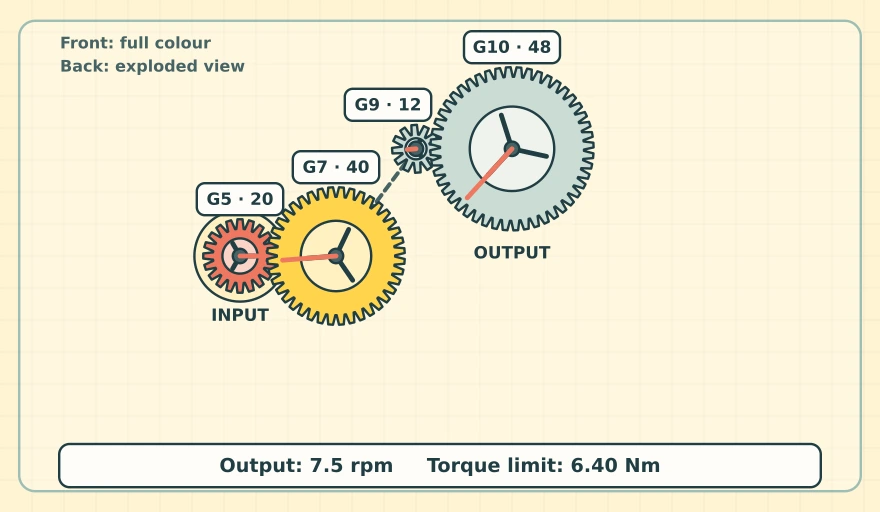
Tooth counts set the speed ratio
Two meshing external gears rotate in opposite directions. If a small input gear drives a larger gear, the larger gear turns more slowly. Under ideal conditions, the lower speed comes with more available torque.
An idler gear in a simple train changes the final direction without changing the ratio set by the input and output sizes. Two different gears fixed to one shaft can connect two stages. Their speeds are equal, and the stage ratios multiply.
Will adding a gear always slow the output? What changes if two differently sized gears share the same shaft?
Try it together in the workshop
- Build two meshing gears. Keep the input at 60 rpm and compare a 20-tooth input with a 40-tooth output.
- Remember the result. Add an idler while keeping the input and output tooth counts unchanged. Compare ratio and direction separately.
- Build two stages with a shared shaft. Raise the output load torque until the model stalls, then change one ratio or the input torque limit.
A worked example
A 20-tooth input driving 40 teeth at 60 rpm produces 30 rpm in the opposite direction. With ideal transmission, 0.8 Nm input torque gives up to 1.6 Nm at the output. A second 12-to-48 stage reduces the combined output to 7.5 rpm and gives an ideal limit of 6.4 Nm.
An activity away from the screen
Use a prepared toy gear set. An adult can secure two gears, then invite your child to predict which way the second gear will turn. Compare tooth counts and add an idler. Observe moving teeth without putting fingers into the mesh.