How can you lift a load with less force?
Place fixed and moving pulleys, choose the rope path and modify the load. Discover how saving pull force changes the amount of rope you must move.
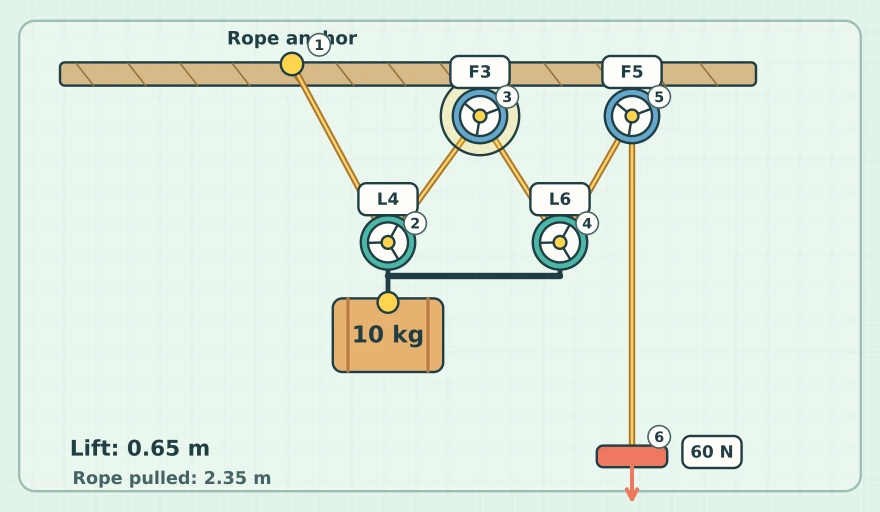
Less force means more rope travel
A fixed pulley mainly redirects your pull. A moving pulley belongs to the load block and can be supported by several rope sections. Their upward tension components combine to support the load.
With vertical supporting strands and ideal conditions, more strands reduce the required pull force. You then pull more rope for the same lift. Angled strands contribute only their vertical component, so counting strands alone does not describe every build.
Does an extra fixed pulley save force, or only change the direction? What happens to rope travel when the load has more supporting strands?
Try it together in the workshop
- Compare one fixed pulley and one moving pulley with the same load and pull force.
- Remember a completed test. Add another moving pulley and route one continuous rope through the new build.
- Change only the anchor or load position. Compare the required starting force, lift and rope travel when the strands become more angled.
A worked example
A 10 kg load weighs about 98.1 N. With one 1 kg moving pulley and two vertical supporting strands, the ideal required pull is about (10 + 1) × 9.81 / 2 = 54.0 N. Ignoring losses, a 0.5 m lift requires about 1.0 m of rope travel.
An activity away from the screen
An adult can prepare a small toy pulley with a light object near the floor. Compare the pull direction first, then try a prepared moving pulley. Keep the activity small: the screen’s displayed loads are not instructions for lifting people, animals or heavy objects.