What makes a lamp light and a motor turn?
Build a circuit with lamps, switches, resistors and a motor. Connect the terminals yourself, then compare current, brightness and rotation.
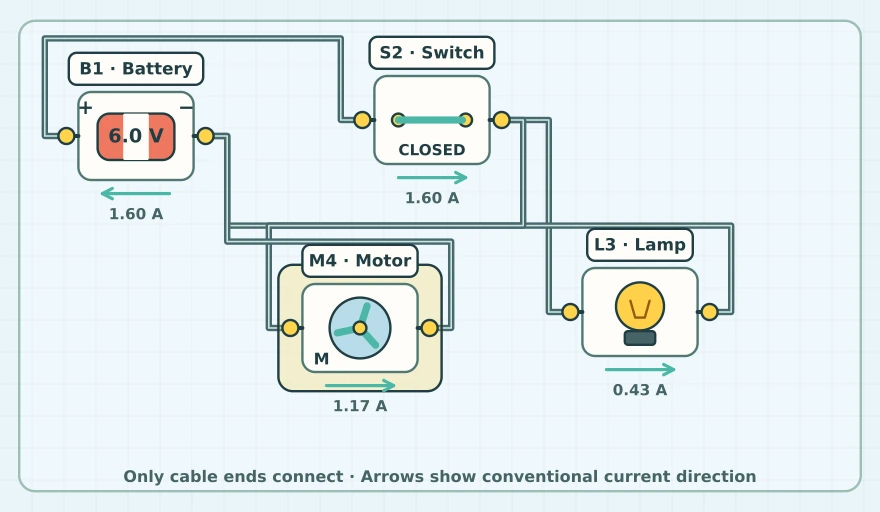
A closed path, then a turning coil
A lamp needs a complete conducting path through both battery terminals. An open switch or broken lamp interrupts that path. A parallel branch can keep working when a different branch opens.
The motor connects electricity to movement. Current in a coil interacts with the magnetic field. The commutator changes the coil current as it turns; back emf opposes the supplied voltage as speed rises. The single-coil model also has starting positions with very little torque.
Will opening one lamp branch also stop the other lamp? What changes if we remove the motor’s magnets?
Try it together in the workshop
- Start with one lamp. Predict what an open switch will do, test, then close the switch.
- Build two lamp branches. Remember one completed test and break only one branch. Compare with two lamps in series.
- Choose the motor experiment and open “Inside the motor”. Remove only the magnets, brushes or coil, then test. Restore the part before making the next comparison.
A worked example
With a 3 V model battery, 0.5 Ω internal resistance and one 12 Ω lamp, the current is 3 / 12.5 = 0.24 A. Two identical parallel lamps share the terminal voltage. The total current rises, so the battery’s internal resistance also matters.
An activity away from the screen
An adult can prepare a ready-made battery-powered educational kit according to its instructions. Ask your child to predict the effect of its switch and observe the lamp together. Do not copy simulated short circuits or connect the activity to mains electricity.