What lifts a boat in a canal lock?
Design a single-chamber canal lock together and investigate water volume, filling time and equalisation.
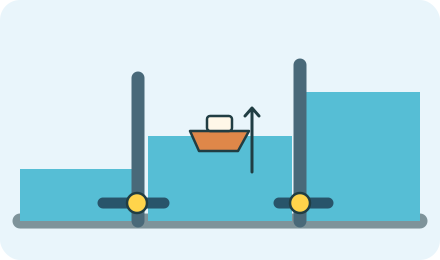
Chamber area, lift and water flow
The boat floats on the water. When water rises in the closed chamber, the boat rises too. A gate connects the chamber to the next canal; it does not lift the boat.
Additional water equals chamber length × chamber width × lift height. A larger opening reduces filling time in the model. It does not change the water volume needed between unchanged starting and finishing levels. Flow slows as the levels approach each other.
Does a wider chamber need more water, more time or both?
Try it together in the lab
- Install both gates, inlet and outlet. Choose dimensions, lift and passage cross-section.
- Test your plan and use the yellow next-step button to take the boat to the other canal.
- Note the volume and filling time. Change only chamber width and compare at the same valve opening.
An activity away from the screen
Mark identical lower and higher filling levels in two flat-bottomed containers of different floor areas. Use a measuring cup to compare the extra water needed between the marks. This compares water volume; it does not reproduce all lock hydraulics.