How do mirrors redirect light?
Build a light course and guide your child through predicting, observing and explaining its path.
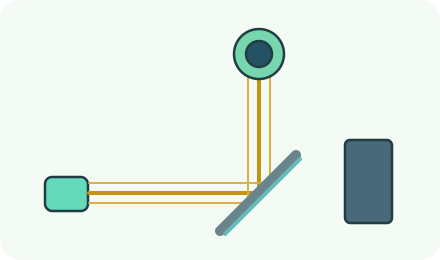
Mirror angles and finite reflective surfaces
The normal is perpendicular to the mirror surface. Angles of incidence and reflection are measured from this line and are equal. Rotating a mirror that is struck by five degrees turns the reflected ray by ten degrees.
A ray reflects only if it actually strikes the bright front of a mirror. Obstacles and opaque backs stop it. Each ray in a three-ray bundle has its own path; a central-ray hit alone does not mean the whole bundle hits.
Will the whole bundle still hit after a small rotation?
Try it together in the lab
- Fix the target and obstacle positions, then build a mirror path for one ray.
- Discuss your prediction and switch the light on. Change only one mirror angle next.
- Choose three parallel rays or a fan. Watch the two outer rays as well.
An activity away from the screen
Shine a small torch at a flat mirror and observe the light spot on a card. Turn the mirror slowly. A broad torch beam is not an ideal single ray, so compare the direction in which the spot moves.